Beyond the Sparkle: Why Handmade Ballet Headpieces Are Worth the Investment
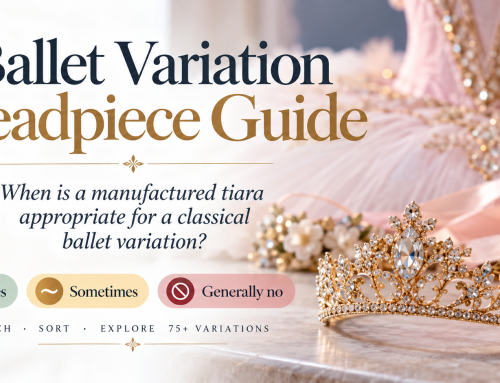
And when a manufactured tiara may be the right choice
In ballet, every detail matters. From the carefully selected fabrics of a classical tutu to the precise placement of embellishments, each element contributes to the overall beauty and artistry of a performance. Yet one of the most important finishing touches is sometimes treated as an afterthought: the headpiece.
A ballet headpiece is not simply something pretty to wear in the hair. It completes the dancer’s silhouette, complements the costume, and helps communicate the character being portrayed.
With so many inexpensive, manufactured tiaras readily available, dancers and parents may wonder whether investing in a handmade ballet headpiece is truly worthwhile.
The answer depends on the dancer’s needs, the production, and the desired aesthetic. While manufactured tiaras certainly have their place, a thoughtfully designed, handcrafted ballet headpiece offers advantages that go far beyond sparkle.
1. Designed for Ballet, Not Just for Decoration
Perhaps the most important distinction between a purpose-built ballet headpiece and a typical manufactured tiara is their intended use.
Many manufactured tiaras are designed primarily for weddings, pageants, parties, or special occasions. Their purpose is decorative, and they may be perfectly suited to those settings. However, ballet introduces a unique set of demands.
One of the most important considerations is how a headpiece is constructed and how it sits on the dancer’s head. A tiara that is beautiful when displayed or worn for a special occasion may not be equally suitable for the stage. Its shape may not conform comfortably to the head; its weight may be poorly distributed or too heavy; or its construction may make it difficult to achieve a secure, balanced fit. These issues become particularly important when a dancer is executing turns, jumps, and other demanding movements.
While attachment methods can often be added or modified to make a manufactured tiara more secure, they cannot necessarily correct problems with its underlying structure, weight, or balance.
Another consideration is how the headpiece responds to theatrical lighting. The rhinestones and other decorative materials used in many manufactured tiaras are not necessarily selected with stage lighting in mind. The quality, cut, placement, and reflective properties of these stones can significantly affect how a headpiece appears under theatrical lights. A tiara that sparkles beautifully in natural light or in a photograph may not produce the same effect when viewed from a distance onstage.
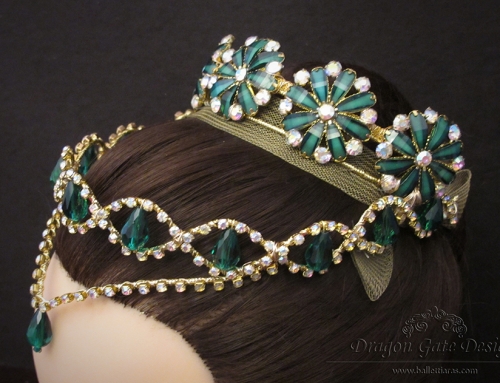
A handmade ballet headpiece allows these considerations to become part of the design process from the beginning. Its structure, proportions, weight, and embellishments can all be selected with the dancer’s movement, comfort, and stage presentation in mind.
It’s not just about keeping a tiara securely in place. It also needs to be designed to withstand the movement and demands of ballet and theatrical settings.
2. A Headpiece Should Complement the Ballet, Not Just the Costume
One of the greatest advantages of commissioning or purchasing a purpose-built ballet headpiece is the opportunity to create something specifically suited not only to the dancer’s costume, but also to the character, setting, and artistic traditions of the ballet being performed.
A classical ballet tutu often represents a significant investment. Its fabrics, embellishments, colors, and overall design have been carefully selected to create a particular aesthetic. The headpiece should be considered with the same attention to detail.
With a custom creation, the designer can consider the costume’s color palette, the shapes and patterns of its embellishments, and the scale of its decorative elements. Equally important are the ballet’s historical or cultural setting, its established costuming traditions, and the identity and social position of the character being portrayed.
Many manufactured tiaras have a distinctly European courtly appearance, often reminiscent of the elaborate ornamentation associated with 18th-century royal fashion. These designs can be beautiful and may be entirely appropriate for certain ballets and roles. For example, this aesthetic may work particularly well in The Sleeping Beauty, with its European court setting, or for courtiers and visiting princesses in the ballroom scenes of Swan Lake.
However, that same style of tiara may be entirely out of place in ballets such as La Bayadère, La Esmeralda, Le Corsaire, or The Talisman. These works have very different cultural settings, characters, and established costuming traditions.
Consider La Bayadère. Nikiya is a temple dancer, while Gamzatti is the daughter of the Rajah. Although they appear in the same ballet, their identities and social positions are quite different, and their headpieces should reflect those distinctions. Even for Gamzatti, whose status calls for elaborate ornamentation, a European court-style tiara may not be the most appropriate choice for the Indian-inspired setting of the ballet.
Similarly, Esmeralda is a street performer, not a member of European royalty. In Le Corsaire, characters inhabit a world inspired by the eastern Mediterranean and Ottoman settings, while The Talisman takes place in an imagined ancient India. A tiara designed to evoke European nobility does little to reflect the identities of these characters or the settings in which their stories unfold.
Even within a ballet whose setting lends itself to European court-style tiaras, not every character should necessarily wear one. The Sleeping Beauty is a particularly good example. While a traditional jeweled tiara may be appropriate for Princess Aurora or the ladies of the royal court, the fairies inhabit a different world. They are magical beings with distinct identities and qualities that can be expressed through the design of their headpieces.
Simply placing the same style of manufactured tiara on every fairy may create a uniform appearance, but it misses an opportunity to reflect what makes each character unique. A headpiece inspired by a fairy’s particular character, symbolism, or magical qualities can contribute much more meaningfully to the overall design.
The fact that a tiara is appropriate to the historical or theatrical setting of a ballet does not automatically make it appropriate for every role within that ballet.
This does not mean that a ballet headpiece must be historically exact. Classical ballet frequently presents romanticized or theatrical interpretations of historical periods and cultures. However, the headpiece should still make sense within the artistic traditions of the ballet and the identity of the character.
A manufactured tiara may coordinate beautifully with the colors and embellishments of a tutu while remaining stylistically inappropriate for the role being performed. Conversely, a well-chosen manufactured tiara may be perfectly suitable when its design genuinely complements the character, costume, and production.
The advantage of handmade ballet headpieces is the opportunity to consider all these elements from the beginning, rather than trying to make an existing design fit a role for which it was never intended.
3. Craftsmanship, Quality, and Longevity
One of the advantages of a handcrafted ballet headpiece is the individual attention given to its design and construction. An experienced designer can select materials and construction techniques based not only on the desired appearance, but also on how and where the headpiece will be used.
A headpiece created for a student performing classical variations at competitions may have very different requirements from one commissioned for a professional ballet production. Both can be beautifully crafted and appropriate for their intended purpose, but they need not be constructed in exactly the same way.
A student may need a headpiece that is lightweight, secure, comfortable, and suitable for occasional performances throughout her training. A professional ballet company, on the other hand, may be commissioning a headpiece intended to become part of a production’s permanent costume inventory, potentially worn by numerous dancers over decades of performances and revivals.
For these long-term productions, durability, maintenance, and the ability to repair or reproduce a headpiece become important considerations from the very beginning of the design process.
A designer can document the materials, dimensions, construction methods, and decorative components used in the original piece. Rhinestone cupchain, for example, can often be sourced again or reconstructed using individual stones and appropriate settings. Sew-on stones, beads, and other embellishments may also be replaced with matching or comparable materials.
If a headpiece becomes damaged beyond repair, or additional copies are needed for future productions, this documentation can make it possible to recreate the original design while preserving the visual continuity of the costumes.
Manufactured tiaras present a different challenge. A design available today may be discontinued several years from now. If a replacement is needed, it may be difficult or impossible to locate an identical piece. Even when a similar tiara is available, differences in its shape, proportions, or embellishments may prevent it from matching the original.
Of course, individual materials used in custom headpieces may also be discontinued. However, a well-documented design offers greater flexibility in sourcing alternatives, reproducing decorative elements, or reconstructing the piece when necessary.
The value of skilled craftsmanship is not simply that a headpiece is handmade–it is that its design, materials, construction, and potential longevity can all be considered in relation to its intended use.
Whether created for a young dancer’s competition repertoire or for a professional production that may be performed for generations, a custom ballet headpiece can be constructed with its particular purpose in mind.
When Is a Manufactured Tiara the Right Choice?
Although handmade ballet headpieces offer considerable advantages, manufactured tiaras can be a practical and appropriate choice in certain circumstances. The key is understanding whether a particular design is suitable for the dancer, the role being performed, and the intended use.
Some manufactured tiaras work particularly well with European court-inspired costumes. A carefully selected design may be appropriate for a court lady in The Sleeping Beauty or a visiting princess in Swan Lake. When the style suits the character and production, and the headpiece is comfortable, secure, and suitably constructed, there may be little reason to purchase a handmade alternative.
Manufactured tiaras can also be practical for young dancers, introductory performances, or large group productions where budgets and the need for multiple matching pieces are important considerations. They may be particularly suitable for short-term use when long-term maintenance or reproduction is unnecessary.
However, affordability, availability, and appearance should not be the only considerations. A manufactured tiara that looks beautiful with a tutu may still be inappropriate for the ballet or character.
The same is true of handmade ballet headpieces. A dancer or parent might purchase a beautifully crafted headpiece designed for a princess and choose to wear it for a slave, street performer, or magical character. Although perfectly suitable for ballet, the headpiece may be entirely inappropriate for that particular role.
Whether purchasing a manufactured tiara, selecting an existing handmade design, or commissioning a custom headpiece, the same principles apply. The headpiece should suit the character and aesthetic of the ballet, complement the costume, and meet the practical demands of the performance.
Ultimately, the value of a headpiece lies not simply in how it was made, but in how thoughtfully it was designed and selected for its intended purpose.
Wondering if a manufactured tiara is appropriate for your ballet variation?
Choosing a headpiece involves more than matching it to your tutu. The character, the ballet's setting, and established costuming traditions all play an important role.
Explore our searchable Ballet Variation Headpiece Guide to discover which classical ballet roles may be suited to a manufactured tiara, which may require a more specialized design, and why.